
Home » Commercial Services » Tree Bracing in North Wales and North West England
Dynamic Tree Bracing in North Wales and North West England
How Dynamic Bracing Benefits Older Trees
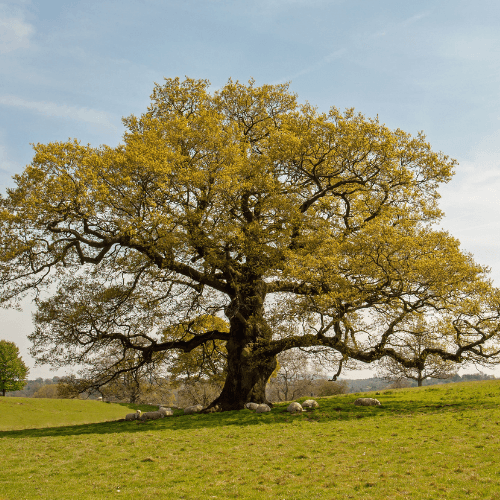
Older and mature trees can be some of the most valuable features on a property. They provide character, shade, habitat and a level of maturity within the landscape that cannot be replaced quickly.
As trees age, however, their structure can change. Heavy limbs, weak unions, multiple stems, historic damage and natural structural defects can all increase the movement and loading within the crown.
When concerns are identified, removal is not automatically the only option.
At Frodsham Tree Solutions Ltd, we assess each tree individually to understand the defect, the likelihood of failure and what is at risk beneath or around the tree. Where retaining the tree is appropriate, Dynamic Bracing can provide additional support as part of a carefully planned tree management strategy.
The objective is not to make a tree risk-free. It is to manage identified weaknesses intelligently and, where possible, allow an established tree to remain safely within the landscape.
What Is Dynamic Bracing?
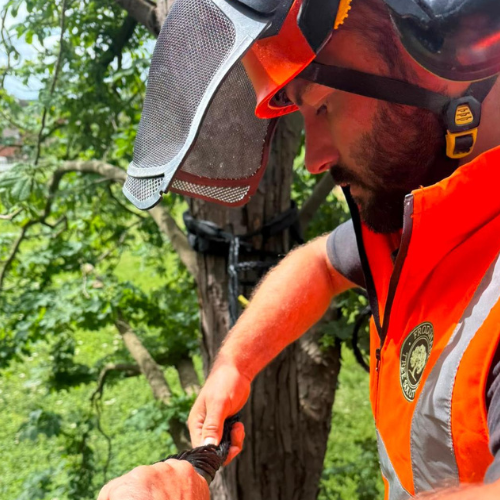
Dynamic Tree Bracing is a flexible tree support system installed within a tree’s crown to help manage excessive movement between limbs or stems.
Unlike traditional rigid systems, dynamic bracing allows a controlled degree of natural movement.
This is important because trees need to respond to wind loading. Movement encourages the tree to adapt and develop supporting wood. Completely restricting that movement is not always desirable.
A dynamic system can instead limit excessive movement at a weak union or between vulnerable stems, reducing the likelihood of movement beyond an acceptable range during strong winds.
The system is installed without drilling into healthy wood, making it a less invasive option than some traditional forms of tree cabling.
Can Tree Bracing Help Prevent Tree Removal?
In suitable circumstances, yes.
One of the main benefits of dynamic tree bracing is that it provides a management option between leaving a defect unmanaged and removing the tree completely.
For a significant mature tree, that can make an important difference.
Removal permanently loses the canopy, habitat, landscape value and environmental benefits that the tree has developed over decades. Where a tree can be responsibly retained, we believe that option should be properly considered.
Tree bracing may be used alongside other arboricultural work, such as selective pruning or crown reduction, to reduce loading on vulnerable parts of a tree.
It is rarely as simple as fitting a brace and walking away.
We consider the tree as a complete structure and decide what combination of measures provides the most appropriate long-term outcome.
Can a Tree With a Split Trunk Be Saved?
A split or cracking tree stem understandably causes concern, but a split does not automatically mean the tree must be felled.
The first step is to understand what caused it and how significant the defect is.
A small developing crack between two co-dominant stems is very different from a major structural failure extending through the main trunk.
We assess the location and extent of the split, the condition of the surrounding wood, the movement between the stems, and the potential consequences if failure occurs.
Where sufficient structural integrity remains, we can sometimes install dynamic bracing higher in the crown to restrict excessive movement between the affected stems.
Pruning may also be recommended to reduce leverage and loading.
In more serious cases, however, bracing will not compensate for extensive structural failure. Safety remains the priority, and removal may still be necessary.
Why Older Trees May Need Structural Support
A large mature tree may have successfully stood for many decades before a structural concern becomes apparent.
That does not necessarily mean the tree has suddenly become unsafe.
Trees continually adapt as they grow. Their weight distribution changes, limbs grow larger, and previous pruning, storms, disease, or damage can affect how forces travel through the crown.
Problems we may assess include:
- large or heavily weighted limbs
- co-dominant stems
- weak branch unions
- cracks developing between stems
- historic storm damage
- cavities or localised decay
- excessive movement within part of the crown
- structural weaknesses associated with previous limb failure
Supporting Weak Limbs and Branch Unions
Some mature trees develop large lateral limbs that carry considerable weight away from the main stem.
Others have included unions or multiple stems where the structural connection is weaker than we would ideally expect.
These features can remain stable for many years, but changing loading, increasing branch weight, or severe weather may increase the likelihood of failure.
Dynamic bracing can provide supplementary support between appropriate anchor points within the crown.
Rather than holding a branch completely rigid, the system helps control excessive movement while allowing the tree to continue responding naturally to normal wind conditions.
For older trees where preserving an important limb forms part of the management objective, this can be particularly valuable.
Can Tree Bracing Help a Leaning Tree?
Assess a leaning tree before deciding on support.
Some trees have grown at an angle for decades and developed perfectly adequate supporting roots and adaptive growth.
A newly developing lean is much more concerning.
Root plate movement, soil failure, wind damage, or structural deterioration can cause a tree to change position, and installing a brace in the crown will not resolve a fundamental root failure.
This is why diagnosis comes before treatment.
Where the concern relates to individual stems or branches within the crown rather than instability of the whole tree, a bracing system may form part of the solution.
Where the root system itself is failing, another management approach is usually required.


Managing Storm-Damaged Trees
Storms often reveal weaknesses that have been developing unnoticed for many years.
High winds can place enormous forces through mature crowns, particularly where there are large lateral limbs, multiple stems or existing structural defects.
Following storm damage, our priority is to determine what has actually changed.
A cracked union or partially failed branch does not always mean the whole tree must be removed. Depending on the extent of the damage, there may be opportunities to reduce the affected crown, remove specific compromised sections and provide additional support to retained stems.
Dynamic Tree Bracing can be particularly useful where a weakness has been identified, but enough sound structure remains to justify retention.
The decision should always be based on the individual tree, not on the assumption that every storm-damaged tree can, or should, be retained.
Bracing Protected and TPO Trees
Older trees are often important not only to the property owner but to the wider landscape.
Some may be protected by a Tree Preservation Order (TPO) or located within a conservation area.
When a protected tree develops a structural issue, finding a proportionate management solution can be especially important.
Tree bracing may help retain a tree while managing an identified weakness, potentially avoiding more drastic intervention where arboriculturally justified.
However, you must still consider its protected status.
Depending on the proposed work and circumstances, you may need permission from the relevant local authority before pruning or other works begin.
We can assess the tree, identify appropriate management options and explain what should happen next.

Why Retain an Older Tree?
Established trees provide benefits that newly planted replacements cannot immediately replicate.
A large mature tree may support birds, bats, insects, fungi and many other organisms. Cavities, deadwood features and mature bark can all form valuable habitats.
Older trees can also make a major contribution to:
- landscape character
- shade and cooling
- carbon storage
- wildlife habitat
- visual screening
- local biodiversity
- the character of historic properties and sites.
None of this means retaining a dangerous tree at any cost.
Where the risks can be appropriately managed, retaining an existing tree can often provide significantly greater environmental and landscape value than removing it and planting a young replacement.
Tree Bracing Is Part of a Management Plan
One of the most important things to understand about Dynamic Bracing is that installation is not the end of the process.
Trees are living structures.
They continue growing, responding to weather and adapting to changes within their crowns. Existing defects can also change over time.
A braced tree therefore needs an appropriate inspection and management regime.
Depending on the tree and system installed, this may include periodic checks of the bracing, reassessment of structural defects and further pruning where required.
We also recommend a tree reassessment following significant storms where there are known structural concerns.
This ongoing approach lets decisions be based on how the tree is actually responding, rather than assuming conditions remain unchanged.
Does Dynamic Tree Bracing Make a Tree Safe?
No professional arborist can realistically guarantee that a tree will never fail.
Tree Bracing is a risk-management tool.
Its purpose is to reduce specific structural risks identified during assessment. It does not remove every possible cause of tree failure, and it does not replace good arboricultural management.
That distinction is important.
Our role is to identify the defect, understand the targets around the tree and decide whether the risk can be managed proportionately.
For some trees, bracing can form an excellent part of that solution.
For others, it would simply delay an unavoidable removal.
Professional judgement is what determines the difference.
When Is Tree Removal Still Necessary?
We always prefer to explore reasonable retention options where an important tree can safely remain.
However, there are situations where removal remains the responsible decision.
These can include significant root plate instability, extensive structural decay, major stem failure or defects where the consequences of failure cannot be adequately managed.
The surrounding environment matters as well.
A tree standing within woodland with no significant targets presents a very different level of risk from the same tree positioned beside a school playground, highway, building or frequently used public space.
That is why we don’t recommend tree bracing simply because a defect exists.
We consider the tree, its location, its condition and what would happen if the affected structure failed.
Is Dynamic Bracing Right for Your Tree?
If you have an older tree with a heavy limb, weak union, split stem or other structural concern, removal may not necessarily be the only option.
Frodsham Tree Solutions Ltd can assess the tree and determine whether the defect can be responsibly managed through pruning, dynamic bracing, ongoing monitoring or a combination of approaches.
Where Dynamic Tree Bracing is appropriate, we aim to retain the tree without compromising the safety of the people, property or infrastructure around it.
And where retention is no longer realistic, we will explain why.
For us, good tree management is not about saving every tree or removing every tree with a defect. It is about understanding the risk, considering the available options and making the right decision for that individual tree and site.