
Professional Veteran Tree Care
Why Veteran Trees Matter and How Professional Tree Care Supports Their Future
Across the UK, veteran trees are found in ancient woodlands, historic parkland, hedgerows, churchyards, estates, farms and public open spaces. They are often instantly recognisable by their character: large, gnarled stems, hollow trunks, retrenching crowns, cavities, deadwood and visible signs of decay.
However, veteran trees are not simply “old trees”. They are living ecosystems, historic landscape features and valuable natural assets. Many have taken centuries to develop the features that make them so important for wildlife, heritage and biodiversity.
Because of this, veteran trees require a very different approach to younger or structurally simple trees. Their management must be careful, proportionate and informed by professional arboricultural tree assessment. The aim is often not to make the tree look tidy, but to retain its value safely for as long as possible.
What Is a Veteran Tree?
A veteran tree is defined more by its features than its exact age. While age can matter, a tree is considered veteran when it develops characteristics associated with maturity, decline, damage, or long-term ecological value.
Common features include:
- Hollow trunks or stems
- Internal decay in stems or limbs
- Large quantities of deadwood
- Fungal fruiting bodies (e.g. bracket fungi)
- Cavities, cracks and splits
- Sap runs and exposed heartwood
- Retracting or reduced crowns
- Historic wounds or failed limbs
- Habitat features used by bats, birds and invertebrates
A veteran tree may eventually become an ancient tree, but the terms are not identical. Ancient trees are usually defined by exceptional age, while veteran trees are identified by their ecological and structural features.
This distinction is important: a tree does not need to be extremely old to have high ecological or heritage value.
Professional Tree Services for Veteran Trees
Veteran trees require sensitive, informed management. Standard pruning approaches are often unsuitable, as excessive intervention can remove valuable habitat or destabilise the tree.
Professional services may include:
- Arboricultural inspections
- Tree risk assessments
- Retrenchment pruning
- Crown reduction to reduce loading
- Selective deadwood management
- Bracing or support systems (where appropriate)
- Root protection advice
- Haloing to reduce competition
- Monitoring of decay and structural change
- Guidance on public access and safety zones
- Long-term management planning
The correct approach depends on the tree, its condition, and its surroundings. A veteran tree near a school, road or footpath requires different management than one in a low-access woodland.
The goal is always to retain value where reasonably safe, while managing risk proportionately.

Common UK Species That Become Veteran Trees
Several UK species are well known for developing veteran characteristics:
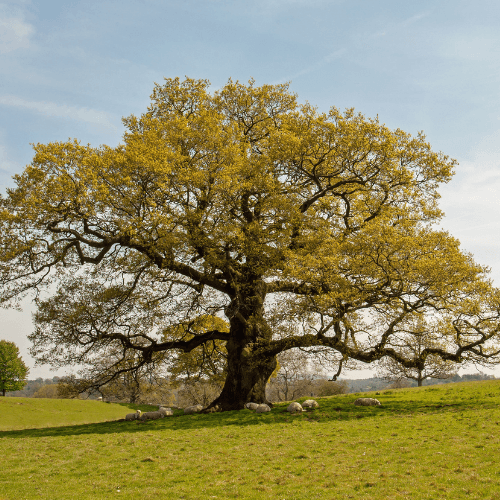
Oak – One of the most iconic veteran species, capable of living for centuries and supporting extensive wildlife habitats.
Yew – Among the longest-lived native trees, often found in churchyards and historic sites, with some potentially over a thousand years old.
Beech – Develops dramatic veteran features such as cavities and large stems, though sensitive to environmental change.
Ash – Common in hedgerows and historic landscapes; now heavily affected by ash dieback, making management more complex.
Field maple, lime, sweet chestnut, Scots pine and willow – All capable of developing veteran features depending on conditions and management history.
The Life Cycle of a Tree
Understanding veteran trees requires understanding tree development:
- Young trees focus on rapid growth and structure formation.
- Semi-mature trees expand in size and canopy.
- Mature trees reach full size and provide significant landscape value.
- Veteran trees enter a late stage where growth slows, crowns retrench, and decay features increase.
Importantly, decline does not mean the end of a tree’s value. With proper management, many veteran trees can remain in stable condition for decades or centuries.
Estimating the Age of Veteran Trees
Tree age is difficult to determine precisely without invasive methods such as ring analysis, which is rarely appropriate for valuable trees.
Instead, arborists often estimate age using girth measurements (CBH – circumference at breast height, typically 1.3m above ground) and species growth rates.
However, this method is only an approximation. Growth varies significantly depending on soil, exposure, management history, and environment.
For veteran trees, ecological and structural value usually matters more than exact age.
Veteran Tree Surveys and Assessments
A veteran tree survey goes beyond basic measurements. It evaluates the tree as a living structure and habitat.
Professional tree surveys & assessments help landowners and managers make informed decisions about retention, intervention or monitoring.
Key considerations include:
- Stem and branch condition
- Decay and fungal activity
- Crown structure and retrenchment
- Deadwood distribution
- Cavities and historic damage
- Root environment and soil condition
- Compaction or construction impacts
- Proximity to people and infrastructure
- Ecological and protected species value
- Need for monitoring or further investigation
Conservation Arboriculture
Veteran tree management is often described as conservation arboriculture. This approach prioritises habitat value alongside safety.
It typically follows a “less is more” philosophy, recognising that decay, deadwood and cavities are often ecologically valuable.
Common techniques include:
Retrenchment pruning – Reducing selected crown areas to lower mechanical stress and mimic natural ageing.
Deadwood management – Retaining deadwood where safe, only removing or reducing it where it poses a clear risk.
Haloing – Removing competing vegetation to reduce pressure on the veteran tree.
Root protection Areas– Preventing compaction and disturbance through fencing, mulching and access control.
Bracing systems – Providing structural support where appropriate following assessment.
Monitoring – Regular inspections to track changes in condition or risk.
Why Veteran Trees Need Specialist Management
Veteran trees are structurally complex. Features such as hollows, decay and deadwood do not automatically indicate danger, but they do require expert interpretation.
Poor or excessive intervention can cause long-term harm, including destabilisation, habitat loss or increased exposure to wind.
Effective management balances safety with conservation, ensuring intervention occurs only where justified.
Veteran Trees and Ash Dieback
Ash dieback has significantly affected veteran ash trees across the UK. Decline can be rapid and unpredictable, so it requires more frequent inspection.
Management depends on location and risk. A woodland ash may be treated differently from one over a footpath, road or school boundary.
Not all ash trees require removal. Some may retain ecological or landscape value even in decline, but timely assessment is essential.
Ecological Value of Veteran Trees
Veteran trees are among the most important wildlife habitats in the UK. Their complex structures support a wide range of species, including:
- Bats
- Birds (including owls and woodpeckers)
- Beetles and invertebrates
- Fungi and lichens
- Mosses and liverworts
- Small mammals
Decaying wood supports saproxylic species, which depend on dead or decaying timber. These habitats take centuries to form and cannot be quickly replaced.
Cultural and Landscape Importance
Veteran trees are also part of the UK’s cultural heritage. They often mark historic boundaries, estates, churchyards, ancient routes and traditional landscapes.
They hold strong local identity and emotional value. Once lost, their centuries of history and ecological development cannot be replaced.
Professional Veteran Tree Care in North Wales and North West England
Frodsham Tree Solutions Ltd provides specialist care for veteran and high-value trees across North Wales, North West England, and Cheshire.
Our approach focuses on careful assessment, proportionate risk management and long-term retention wherever possible. Where intervention is required, we carry it out safely and with respect for both tree health and habitat value.
We are proud to support ex-service personnel, service leavers, and veterans looking to build meaningful careers in arboriculture and utility arboriculture.
The skills developed through military service, including discipline, teamwork, leadership, problem-solving, resilience and a strong safety mindset, transfer naturally into professional tree work.
Arboriculture can provide a practical, rewarding career path for those who want to keep working outdoors as part of a skilled team while developing specialist technical knowledge.
As a veteran-led business, we understand the value that ex-service personnel can bring to the industry. Through training, mentoring and real site experience, we aim to help people move confidently into roles where safety, responsibility and professional standards matter every day.
This commitment sits alongside our wider approach to professional tree care: careful planning, high standards, respect for the environment and a practical understanding of risk.