
Scenario Overview
Following a busy Easter weekend of emergency call-outs before and after Storm Dave, we attended a site at Wirral Country Park Caravan and Motorhome Club.
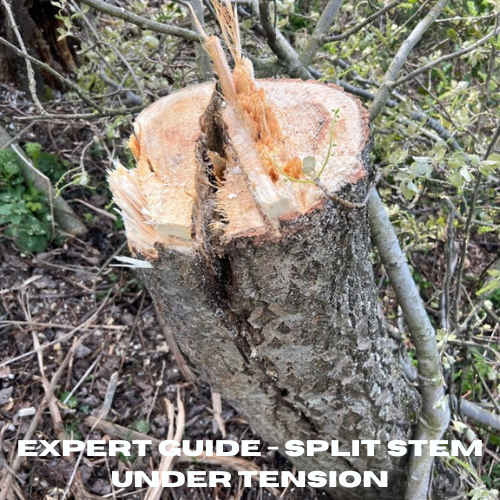
The job involved a semi-mature poplar with a 4 metre longitudinal split running up the main stem, leaning directly over a caravan pitch.
Initial Assessment
On arrival, a full dynamic risk assessment was carried out and documented.
There was sufficient space on site to fell the tree, so a cherry picker was not required. However, the split significantly increased the level of risk.
The primary concern was the potential for a barber’s chair if the tree was felled using conventional methods. Because of this, a more controlled approach was essential.
The Challenge
A split stem under tension behaves unpredictably. Internal forces within the timber can result in sudden and violent failure during a standard back cut.
While it may be tempting to simply cut through the back and hope for the best, this approach is unsafe and can lead to catastrophic outcomes, especially given the extent of the split.
The FTS Approach
Step 1: Directional Cuts
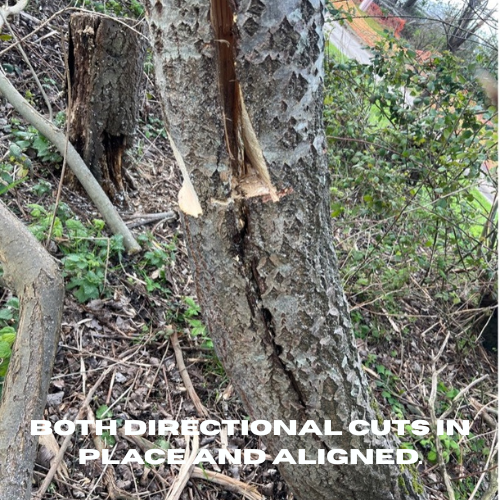
Two conventional directional cuts were made, both facing the intended direction of fall.
This established control and helped form a hinge across the split sections.
Step 2: Alternating Back Cuts
Rather than committing to a single back cut, we alternated cuts between the two back cuts, gradually feathering them inwards.
This allowed the tension within the stem to be released in a controlled manner, reducing the risk of sudden failure.
Step 3: Hinge Control
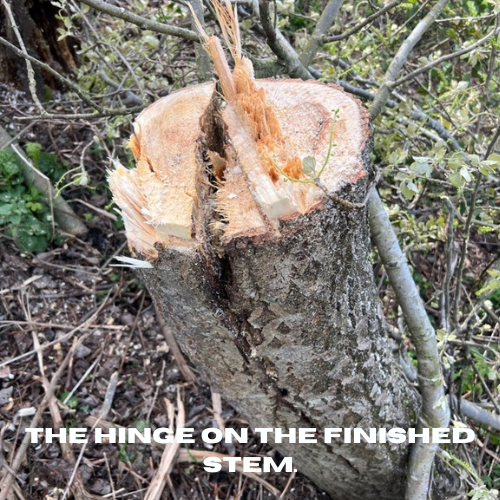
The hinge was carefully maintained throughout, ensuring even holding of wood across both sides of the split.
This enabled the tree to come over in a controlled and predictable way
The Outcome
The tree was safely brought to the ground without further splitting or damage to the surrounding area. Full control was maintained throughout the operation.
Key Takeaways
- Never treat a split stem as a standard fell
- Always assess internal tension and the risk of a barber’s chair
- Use controlled, staged cutting techniques to manage energy release
- Maintain hinge integrity at all times
Final Thoughts
A Note on Safety
Tree surgery is a highly skilled and potentially dangerous profession. The methods shown here are carried out by trained and insured professionals.
This post is intended to showcase how we approached this particular job, not to serve as a how-to guide.
Situations like this highlight the importance of planning, experience, and precise cutting techniques.
Every tree and tree felling scenario is different. The method used here was specific to the conditions on site and should not be considered a one-size-fits-all approach.
Tree work is a skilled and high-risk profession, and all work should be carried out by trained and qualified professionals.
Learn More About Frodsham Tree Solutions
Frodsham Tree Solutions provides professional tree surgery and commercial arboricultural services across North Wales and North West England.
All work is delivered in accordance with BS 3998, supported by recognised industry accreditations, and carried out by a disciplined, veteran-led team.
Based in the North West of England, we are ideally situated to conduct tree services in Cheshire, The Wirral, Merseyside, Greater Manchester, North Wales and Lancashire.
For professional advice or a detailed quotation, contact Frodsham Tree Solutions today.
Expert Advice From Chris Whitby. Company Owner and Lead Arborist